
 Jill Medinger
EQ: Can you tell me a bit about your career and how you got to where you are today? What led you to an interest in art? Was there an inspiration that led you to specialize specifically in horse racing and equestrian subjects?
AB: After a brief career in automotive management, I spent four years at Edinburgh College of Art, gaining a qualification in drawing and painting. My immersion in the visual arts continued with lecturing, setting up art at the junction, and event management, but also committing to developing my own work, which included welded steel, bronze, and ceramic sculpture. For a number of years, live drawing from the model has been a weekly imperative.
Why horses? The following quotes sum up my position: “They are creatures of pathos and empathy, but more to the point, a very aesthetically pleasing jumble of lines and shapes.”
“If I paint a wild horse, you might not see the horse, but surely you will see the wildness…” These views have underpinned my equestrian art for the past quarter of a century.
EQ: Looking back at your career, which accomplishment do you feel best represents your artistic evolution?
AB: On reflection, I would think that my residences at the likes of Glorious Goodwood, The Gold Cup at Cheltenham, the Royal Windsor Horse Show, and Show Jumping at Olympia had a lasting effect. You are working live in front of discerning and knowledgeable enthusiasts. No hiding place!


EQ: Your work is known for conveying the “passion and power” of the sport. What is it about the form, movement, and spirit of a horse that you find most compelling to translate onto canvas?
AB: Very importantly, in the vast majority of my work, the rider is as vital as the horse, an integrated unit driving forward. I’m not so hot at doing horses standing in a field!
EQ: Could you describe the concept behind Fine Art LIVE? How has this format impacted your artistic process, and what kind of engagement do you see from the audience during a live creation?
AB: This project has two distinct parts: One is for corporate events. At fundraising, client presentations, or other corporate events, I create a picture, usually large and on canvas, that is auctioned during the course of the event, usually for charity.
The second is for equestrian and sporting events. It’s an opportunity to get the work out of the studio and into the public domain. Big live painting creates interest and generates sales—way better than galleries. The downside: five nights camping at events like the International Horse Trials at Scone Palace with attendant Scottish weather!
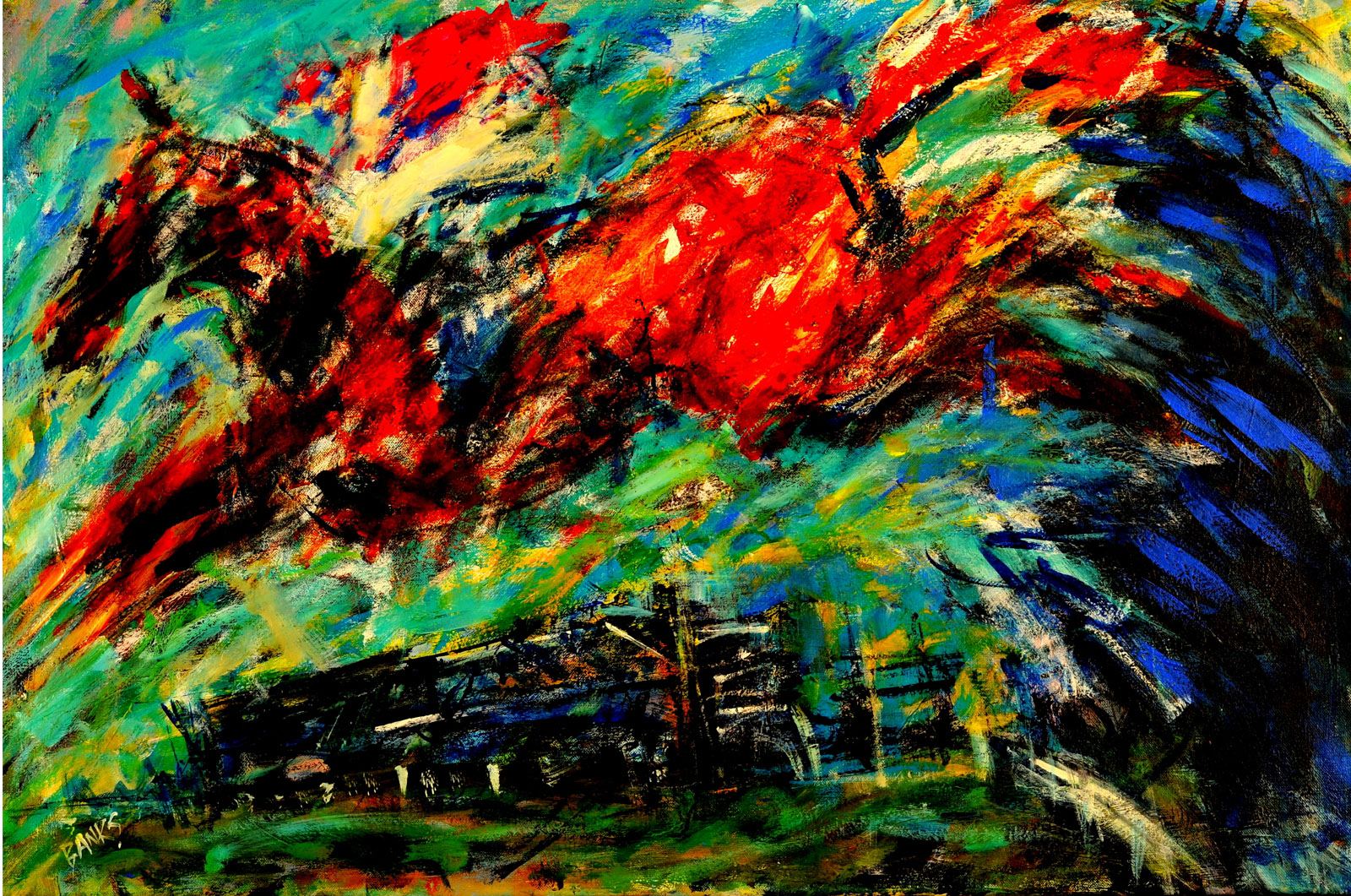
EQ: Your use of bold color is a striking trademark, with horses often appearing to “storm out of a bright blue or hot red base.” Could you walk us through your color theory, and the emotional impact you aim to create with these vibrant, high-contrast backgrounds?
AB: As to “color theory,” I don’t have one! Just intuitive, expressive stuff. Sometimes it works, often it doesn’t. I’ve got a big wastepaper basket.
EQ: On the flip side, I’ve seen your monochrome drawings – what do you think is the value of working in black and white?
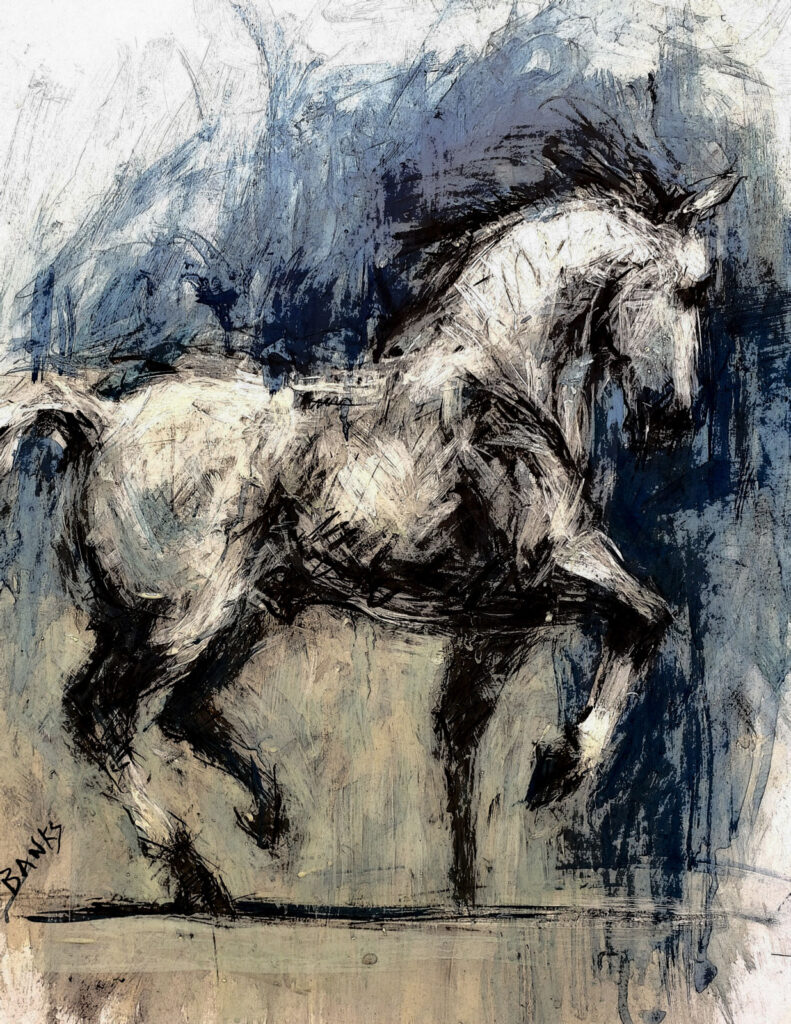
AB: I work a lot using only charcoal, conte crayon, and most importantly, a rubber. Without the sometimes distraction of color, form can be explored and exploited to express the movement. The work of artist Frank Auerbach has been a constant inspiration. His use of these simple, timeless materials is really powerful. The drawing “Polo Mix” is my take on his style.
EQ: You work in a wide range of mediums—from large canvases to small ink studies, watercolors, and pastels. How do you decide which medium and scale are best suited for a particular subject or mood?
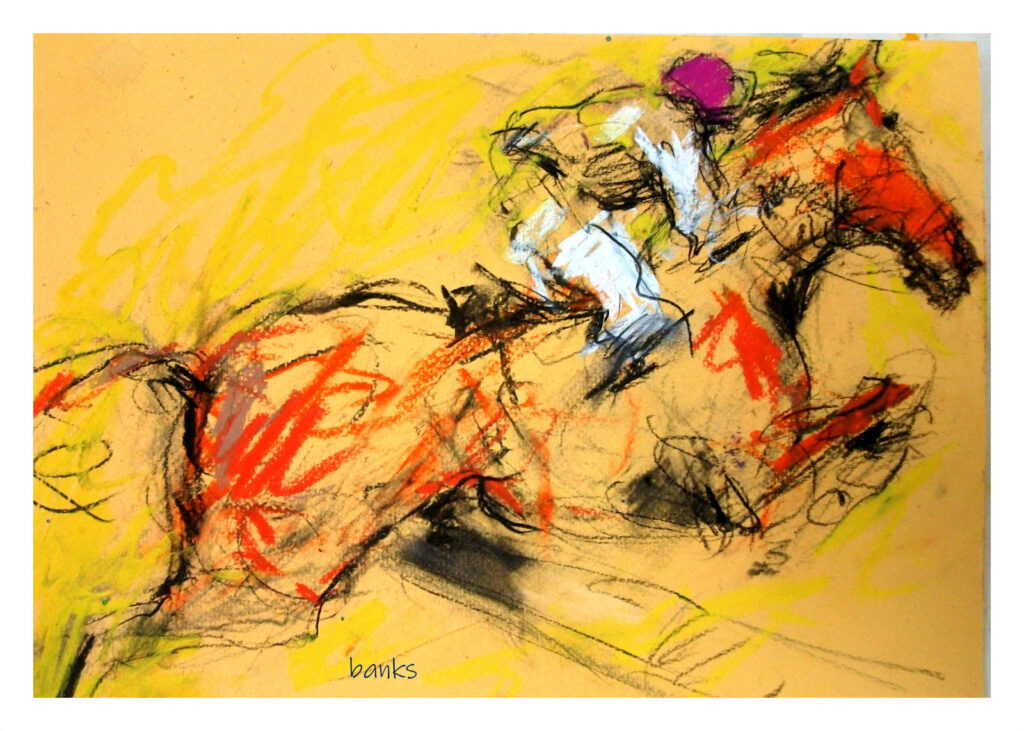
AB: Clearly, the traditional oil/acrylic technique on canvas is required for anything larger than five feet. For smaller work, the surface, whether paper or board, is critical, as my expressive technique that can combine conte, acrylic, pastel, and pencil in one picture needs a robust working surface. I often work over discarded prints, allowing some of the original colors to show through, creating a palimpsest, in other words.
EQ: When beginning a new composition, what does your preparation involve? Do you rely on photographs, sketches, or purely memory and imagination to translate the initial dynamic observation to your work?
AB: Beginning a new picture. Over the years, I have completed many commissions which impose their own constraints, scale, relative realism, the colors of jockeys’ silks, frame, etc. For all other work, I resort to my comprehensive art library, myriad working drawings, and photographs. There aren’t a lot of horses in Glasgow City to work directly from!
I would like to thank my friend John Thorley of Equestrian Art Ltd for his help and support over the past 20-odd years.
About Alasdair: Alasdair Banks was born in Edinburgh, Scotland, and studied drawing and painting at Edinburgh College of Art. He went on to work in arts management, part-time lecturing, and exhibition curation. During this period, he began creating large charcoal and pastel works focused on sporting events, particularly equine sport. His dynamic, energetic style stood apart in a field often defined by photo-realism. A collaboration with Olympia International Show Jumping in 2000 led to a series of prestigious residencies that centered on public engagement. Working in front of audiences became a defining part of his artistic practice and ultimately inspired the creation of Fine Art Live, which has since been featured at major events including Badminton, Hickstead, and Chatsworth. A three-year association with Lloyds Banking Group followed, featuring live events at venues including the Savoy, the Museum of Wales, and the Edinburgh Festival. He later undertook residencies at Glorious Goodwood and the Festival of Speed, producing large-scale outdoor works under public observation. Recent partnerships with Aston Martin, Volvo, and Lotus have expanded his motorsport profile, and he is currently the resident artist with the Jim Clark Trust. He is an associate member of the Society of Equestrian Artists.