 Sarah Lessler
Working primarily in clay and casting in bronze, Holly captures the essential nature of her subjects, placing the horse at center stage.
PHOTOS BY Russel Sach
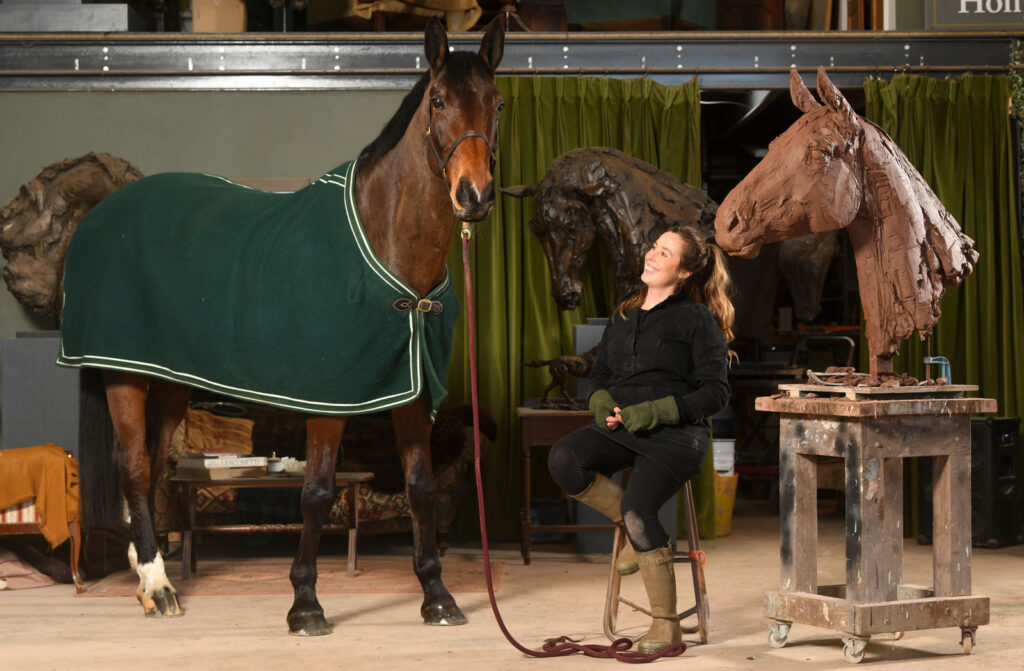
Sculptor Holly Hickmore in her studio with Frank, her horse who has been an inspiration for one of her studies, a portrait of ‘Quality Van De Heidi’.
Q: Where did you grow up, and how did those surroundings shape your creative instincts?
“I grew up in a small rural hamlet about half an hour from the nearest town, surrounded by animals and open countryside. My father kept pigs, goats, turkeys, chickens, and a rather intimidating goose—so from an early age, I was immersed in the rhythms and realities of animal life. I was something of a tomboy, usually found outdoors in wellies, though often paired with a pink tutu in an unconventionally cute way. I must have raised a few eyebrows leading goats around in that outfit, but those moments gave me an instinctive understanding of animal behavior—even if it mostly meant learning how not to be knocked over at feeding time.
I learned to ride at a farm in the neighboring village, and from that first experience, I was completely hooked. The stables became my paradise, a place where I wanted to spend every spare minute. I was convinced I was destined to be a famous show jumper, and I devoted a great deal of energy to persuading my parents that the next step was to get a pony of my own.
Over a decade later, life has come full circle. I now live on that farm, beside my studio, with my horses’ paddock just outside—something my 10-year-old self would hardly have believed possible. Growing up so closely connected to animals shaped not only my childhood but also how I observe form, movement, and character as a sculptor today.”
Did you know intuitively that your early artistic interest would become an impassioned career pursuit?
“In many ways, it felt as though sculpture found me rather than the other way around. As a child, when I wasn’t riding or playing with horses, I was drawing them. I never consciously set out to become a professional artist, though the need to create was always there, instinctive and constant. The career itself feels like a natural byproduct of that deeper impulse to make sculpture.
Each finished piece seemed to create the need for the next. Every sculpture brings its own challenges—questions of form, balance, movement, or expression—and solving one leads naturally to another. It becomes a continuous, evolving process, almost a conversation between the work and myself. It’s as though the work has always been quietly guiding me forward.”
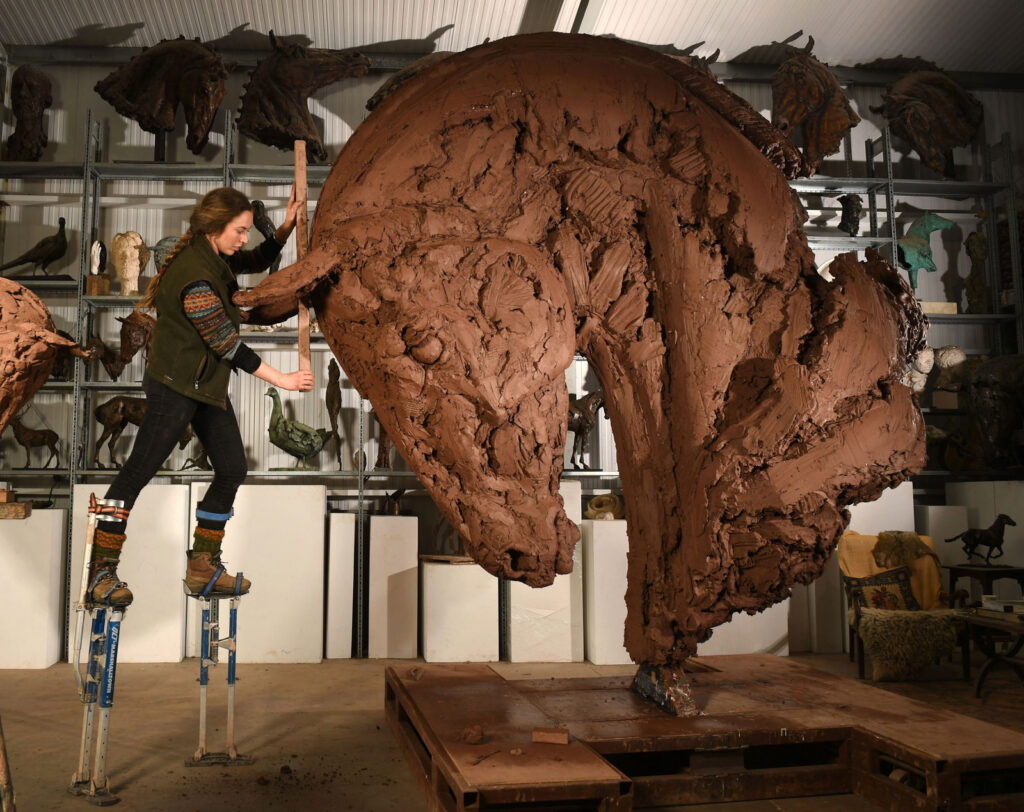
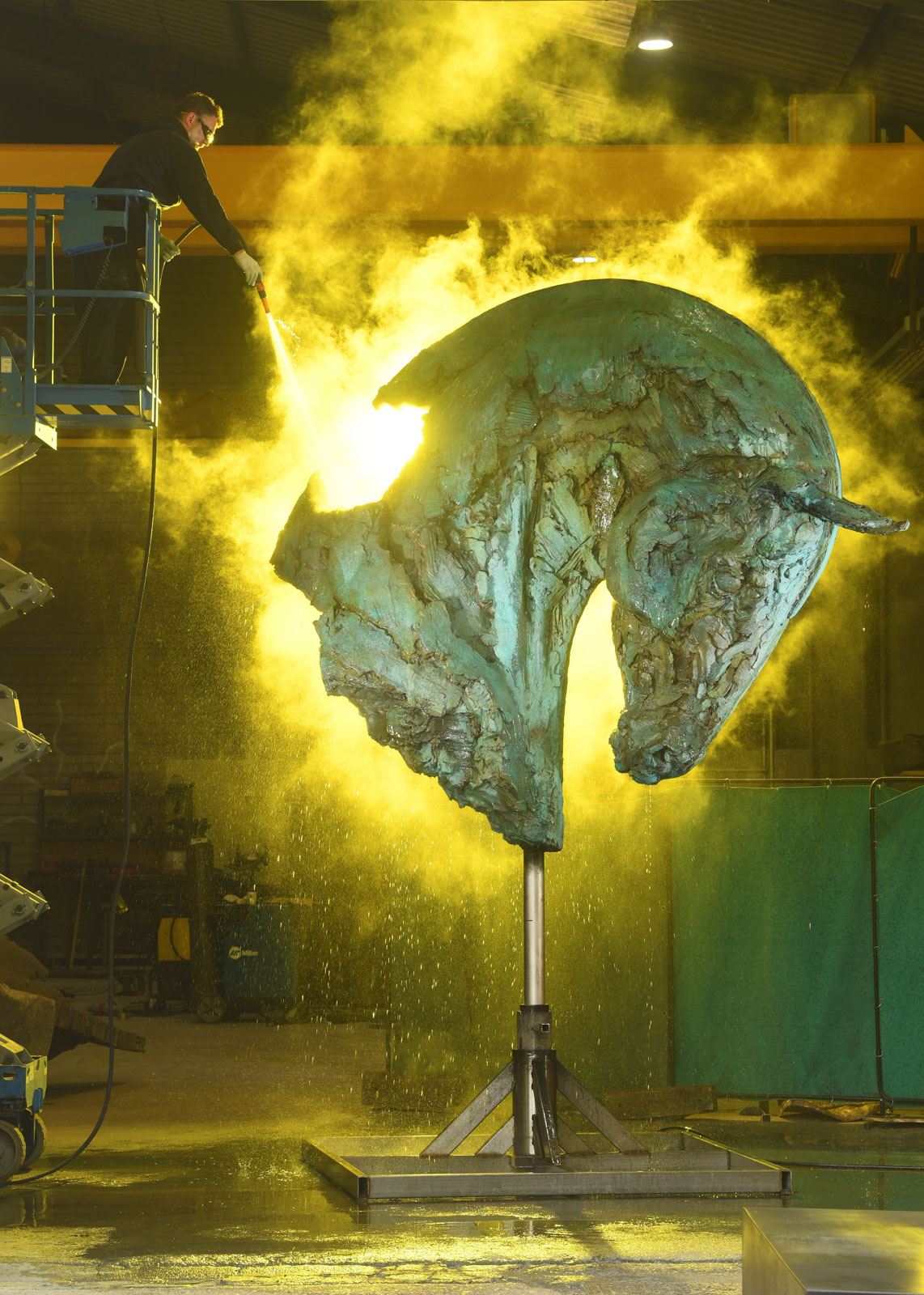
Recycling three tonnes of clay, Sculptor Holly Hickmore introduced sand, terracotta and broken sea shell’s to raise the texture of ‘ Artemis ’ a 3.5 meter tall horses head that has taken five months to complete in her West Meon studio.
The largest work she has created to date will be cast in bronze by the Morris Singer factory among the hills of the South Downs, ready to take pride of place in the Royal Enclosure at Royal Ascot in June.
Q: You were competing as a show jumper at one point. Was that a time when you were balancing your focus between art and riding? What gave you the confidence to fully commit to sculpture?
“There was a time when my focus was split between riding and art. I took my horse to college to join the show-jumping academy, with dreams of a future in the sport. Alongside that, I was studying my A-levels, with art as one of my subjects. During that period, I felt a distinct shift—from the pull of the stables and the next competition to an equally strong draw toward the art studio. It was there that I truly discovered sculpture.
Choosing to continue studying art after college meant making the difficult decision to sell my horse. He was the horse of my dreams—exceptionally talented and deeply loved. Letting him go was heartbreaking, but it meant committing fully to sculpture and making that sacrifice meaningful. It gave me the resolve and clarity to pursue art wholeheartedly.”
Q: Was working in clay an immediate choice, or did you explore other mediums first?
“I spent time exploring several departments at art school, but I always found myself drawn back to the sculpture studio. It was the space that felt most instinctive to me.
I’ve always enjoyed working with clay—it’s essentially playing with mud, and any day one returns home splattered with it is generally a great one. I find no other medium offers the same immediacy of expression as clay. It’s wonderfully responsive yet quietly resistant. It has a will of its own, creating an intriguing dialogue between intentional mark-making and the material’s raw state.”
Q: How do you decide which subject to work on next? Do you work on multiple pieces at the same time?
“I usually work on several sculptures at once—often three or four at different stages. Alongside my own body of work, I take on a select number of commissions each year. Regardless of their origin, the pieces tend to exist in conversation with one another. One sculpture often sparks the impulse to make the next; finishing a piece often leaves me wanting to make five more. Ultimately, I sculpt whatever compels or inspires me at that moment.”


Above Left: Zizi Be Cool Bronze. Above Right: Marengo Bronze Patination at the Morris Singer Foundry.
Q: Does your deep connection with horses influence how you approach equine forms in your work?
“Horses communicate through physical gestures, and those of us who live and work with them spend countless hours learning to read that language. I return to the horse repeatedly as a subject because that physical vocabulary allows me to express something far beyond anatomy. A sculpture isn’t merely something that resembles a horse—it can speak of love, freedom, strength, power, or vulnerability.
Horse people develop an instinctive empathy, reading emotion in subtle shifts in posture or movement. There’s a strong parallel between that sensitivity and how I approach sculpture. Just as we learn to read a horse’s physical language, I read the language of form, gesture, and tension within the clay.”
Q: Do you enjoy working en plein air to capture wildlife and their habitats?
“Studying wildlife in its natural environment is incredibly important to me. Observing animals—whether wild or domesticated—in settings where they feel at ease reveals their true character and behavior. A creature in a studio can move very differently than it does in its own field, stable, or habitat, so spending time watching them where they are most comfortable is essential to truly understanding them.
I often sketch or photograph subjects outdoors, then bring that information back into the studio to develop the work. The aim isn’t just to record what I see but to absorb a sense of presence and atmosphere. When I’m back in the studio, I can translate those impressions into the language of sculpture, so the finished piece carries aspects of that authenticity.”


Left: Artemis Maquette Olympian Series: Interior bust Bronze edition of 9. Right: Artemis Olympian Series Bronze Limited edition of 3
Q: Can you tell us about your Olympian series? Was Artemis your largest piece to date?
“The Olympian series consists of more abstract works. Rather than capturing a particular horse or breed, the series explores the horse as an enduring artistic motif, beginning in ancient Greece. Horses have played a profound role in civilizations throughout history; the relationship between humans and horses is as old as time, woven into mythology, warfare, sport, and daily life. I’ve always been deeply moved by ancient sculptural fragments—their rugged surfaces, their sense of survival, and the way they’re celebrated in their raw, incomplete state.
Hellenic depictions of horses are extraordinary from an aesthetic perspective. To stand before them and feel the thoughts and sensitivities of another civilization is almost overwhelming—it collapses time. That sense of continuity and dialogue with the past inspired this body of work.
Artemis is currently the largest piece in the series and my largest bronze to date, standing 15 feet tall.”
Q: What were the greatest challenges and rewards of working on Artemis?
“The greatest challenge was its sheer physicality. Working at such a height demanded new mechanical solutions and structural thinking. With the right tools in place, it suddenly felt as though I had the reach and strength of a large team with me at the studio. That shift was liberating—it opened possibilities rather than imposing limits—and has inspired me to think even bigger for my next piece, pushing how far an idea can go.
The most rewarding aspect wasn’t simply the monumentality of the piece but the effect it has on the viewer. Sculpture at that scale alters your sense of proportion and changes your relationship to the form. In many ways, it returns me to the feeling I had as a child standing beside a horse, looking up in awe and admiration.”


Left: Gaia-Olympian Series equestrian bust. Studio image in clay Bronze edition of 9. Right: The Greet Interior equestrian figure composition. Bronze edition of 9.
Q: How closely do you collaborate with your foundry when selecting the final patina?
“Each bronze sculpture involves a remarkable team of skilled artisans as it moves through the stages of the lost-wax casting process—a technique that has remained largely unchanged for millennia. The final stage, applying the patina, is among the most collaborative aspects of the process, especially between myself and the patination specialist at the foundry.
Selecting the final patina is an artistic and personal decision. Sometimes it is inspired by the subject’s colors or the landscape it inhabits. For example, we chose a lunar-toned Verdigris patina for Artemis that echoes the mythology of the Greek goddess after whom it is named.”
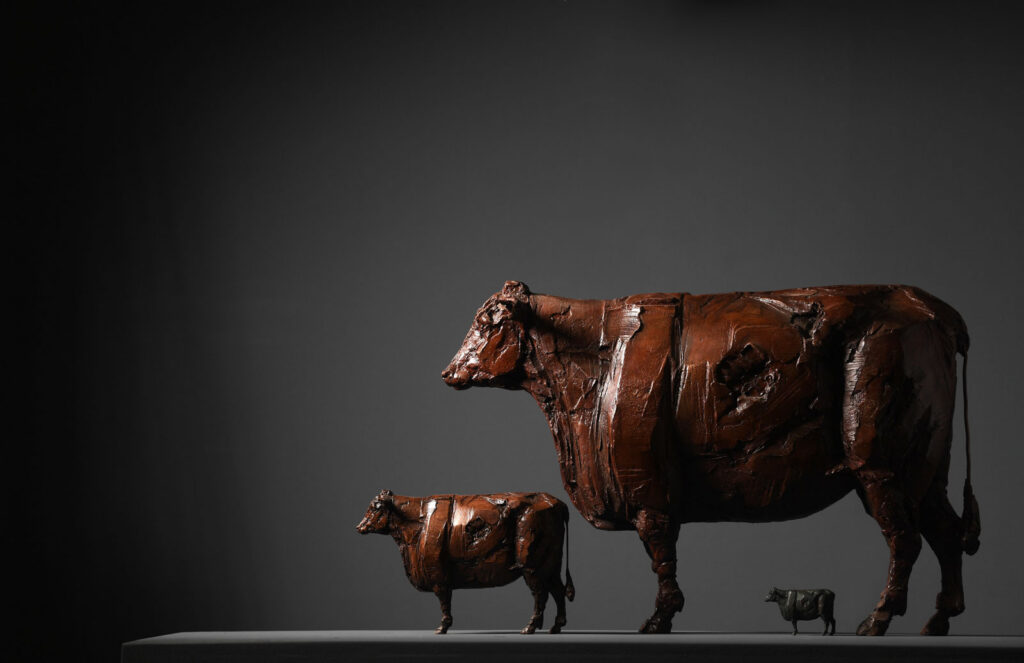
Cow Farmyard Series Bronze edition of 9 (In three sizes.)
Q: Once a sculpture is complete, does your satisfaction come from seeing the finished form or from something more internal?
“When a sculpture is cast in bronze, it feels as though it has been frozen in time. Every gesture, every fingerprint, every considered mark becomes permanent—something that will outlive me, my children, and generations beyond. In that moment, the work becomes greater than me; it becomes itself.
Seeing the finished piece is like meeting an old friend—familiar yet full of so much still to discover. There’s a sense of acceptance that’s hard to achieve while a sculpture is still in clay, with decisions still unfolding and nothing feeling final.
The ultimate satisfaction often comes later, when the piece finds its new home. Seeing it come to life in someone else’s space, through someone else’s eyes, is deeply rewarding.”
Q: Do you still enjoy casual time on horseback?
“Yes—I still very much enjoy time on horseback. I ride my Belgian Warmblood, Frank, who is a constant source of inspiration. He’s become remarkably comfortable in the studio, standing in for other horses as I work on the biomechanics and mechanics of pose. He sometimes gets a little too involved, often leaving the studio with clay on his nose! In many ways, he’s both my toughest critic and my greatest teacher.
Riding is also where my mind feels most free. It’s a wonderful way to observe wildlife without disturbing them, and new ideas or directions for my work often emerge during those outings. Time on horseback remains both a joy and a crucial part of my creative process.”
To view this article in the digital EQ Living Magazine Spring 2026 Issue, click here.