 Sarah Lessler
Discusses movement, muscle, and the art of the horse.
Interview by Stephanie Peters
“I’ve observed tough little ponies in their thick winter coats, and inquisitive skewbald horses secretly taking an interest in me.”
Along with portraits, figurative work, and landscapes, horses appear throughout your work with remarkable sensitivity and presence. What first drew you to the horse as a recurring subject?
I first learned to ride on my 30th birthday, after my wife gave me a riding lesson as a gift. I have an adventurous spirit, and the thrill of riding excited me. In my 30s, I competed in cross-country and rode polo ponies, whose agility amazed me.
From then on, horses, in all their magnificence, grandeur, and beauty, have interested me. I’ve observed tough little ponies in their thick winter coats, and inquisitive skewbald horses secretly taking an interest in me.
I’ve been to horse fairs and shows. The hustle and bustle as owners show off their fine horses and tough little ponies make horse fairs very lively and exciting occasions.
I paint what excites me, and I paint what I know. I endeavor to create work that is a response to a place or moment—partly from memory, partly from the sketches that I make on location, and partly from source material—combining these together for a finished composition. I continuously draw and make sketches from life and from varied references.
Movement is one of the greatest challenges in equine art. Do you work from life, sketches, memory, or a combination of all three to capture it? Does photography play a role?
I’ve always drawn; for me, it’s the bedrock of creativity. When you draw or sketch, you observe and respond subconsciously, making alterations to the drawing without thinking—reacting automatically to what’s in front of you. Drawing allows me to capture the movement and feeling without getting locked into detail.
I use drawings as the starting point for most of my paintings, often combining more than one into a finished artwork, and I use photographs to assist my memory.
For me, there’s ‘Observational drawing,’ and there’s ‘Drawing for a purpose.’ The discipline for each is slightly different.
With ‘Observational drawing,’ you respond directly to what you see in front of you, soaking up the feeling as you go along, and storing some of it in your head for later. These drawings sometimes become finished artworks in themselves, as it can be hard to improve on them.
With ‘Drawing for a purpose,’ you have a painting composition in mind, bringing together elements from existing sketches, what you remember, and other references, redrawing and refining them to create the composition.
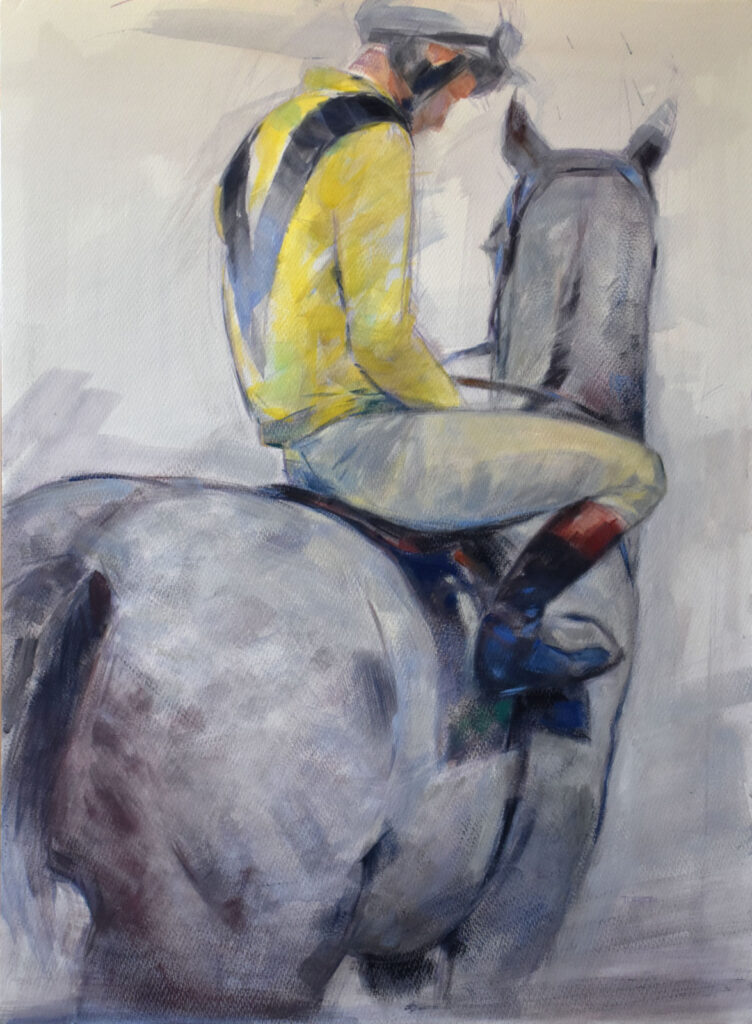
Can you describe your process from a blank canvas to a finished piece? Do you plan everything out in advance, or discover the painting as you go?
A painting doesn’t just happen—the finished painting may look simple, as if it’s just come together—that’s the feeling I want my work to have when it’s complete. However, it’s a process that involves observational sketching, laying out, blocking in, amending, and finally completing.
A question I’ve often been asked is: ‘How long did it take you to paint it?’ My answer is invariably, ‘Hours sketching and observing, time thinking about it, more hours to do the actual painting, and 40 years of experience.’ The experience is the bit you can’t quantify, but it’s the bit I can’t do without. It’s the experience that enables me to take things out, simplify, and create marks that are beautiful in themselves.
Color and light seem central to your paintings. How do you develop your palette for a new work, and are there certain colors you return to again and again?
The palette of colors I use for the finished painting is generally influenced by the original colored drawings. It’s at the drawing stage that I respond intuitively to the subject. I’ve gone back and forth to previous color schemes many times, but new schemes keep presenting themselves, and I’m open to exploring new avenues of color.
Horses carry symbolic weight, such as freedom, grace, and power. When composing a piece, are you thinking about those qualities or focusing more on the visual and technical challenges?
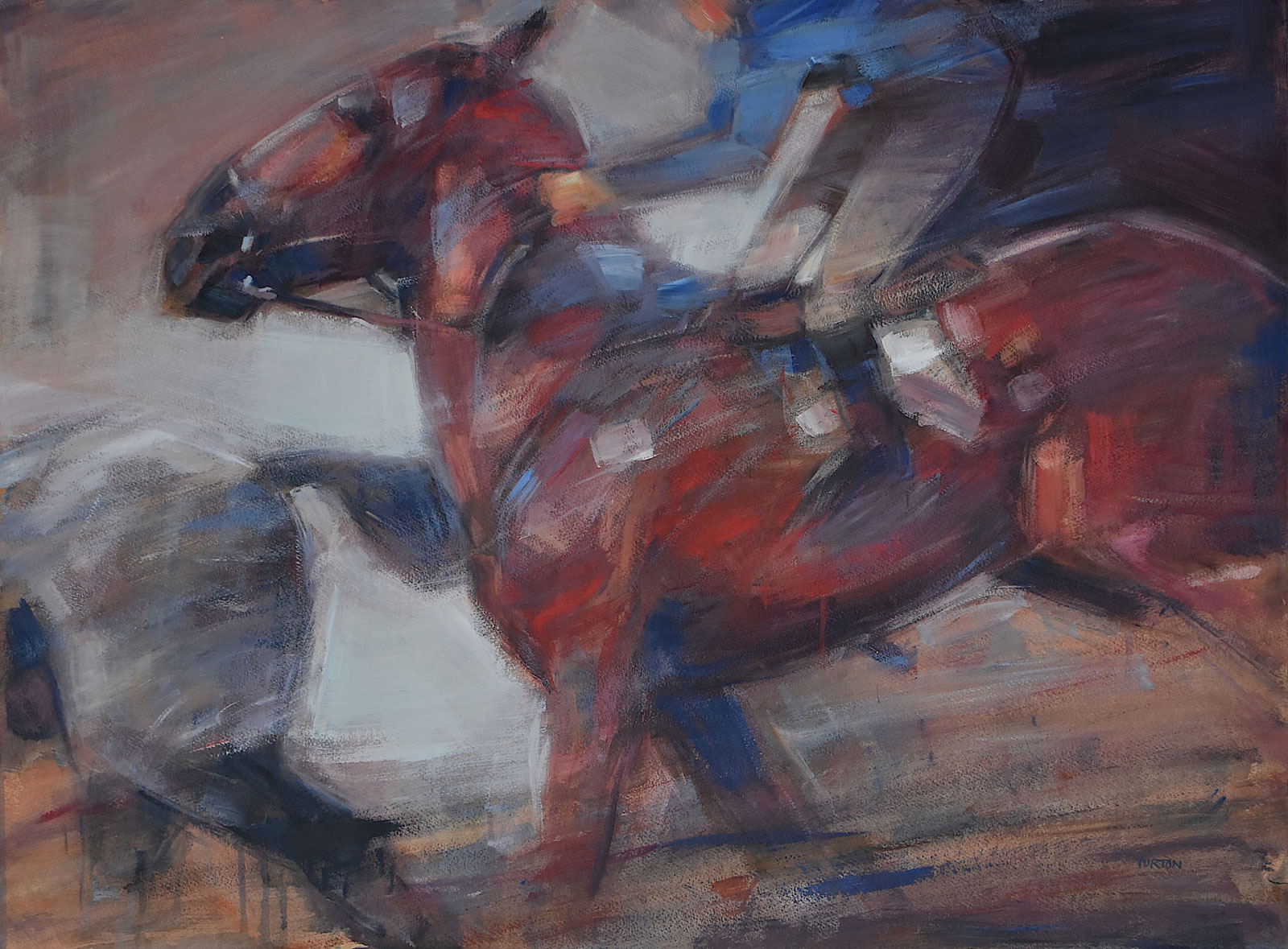
I concentrate on all aspects of the specific horse I’m trying to represent. This can include capturing speed, the horse’s weight, the horse’s grace and solidity, or the jockey’s tension, while endeavoring to create an interesting composition that isn’t slavishly representative.
Horses have shown up in your work since early in your career. What environments do you find the most compelling to place them in?
Horses have appeared in my work for at least 35 years, and I keep returning to them as a subject—enjoying the varying themes each time. Each theme, from horse racing to rough ponies in a field, has its own challenges, and each time I try to capture and represent the feel—not necessarily painting horses and riders in exactly the same way.
Repetition isn’t something I do; that’s why my body of work also covers other themes, from landscapes to portraits. An example of this is my love of the coast and the sea, and I hope my coastal work reminds viewers of their own special times by the coast. For me, my paintings are about my experiences and my joy. I really love the coastline that surrounds the UK, from its wild Scottish cliffs to the crumbling sandstone of the Jurassic Coast, crashing waves in Cornwall, or flat, wide beaches.
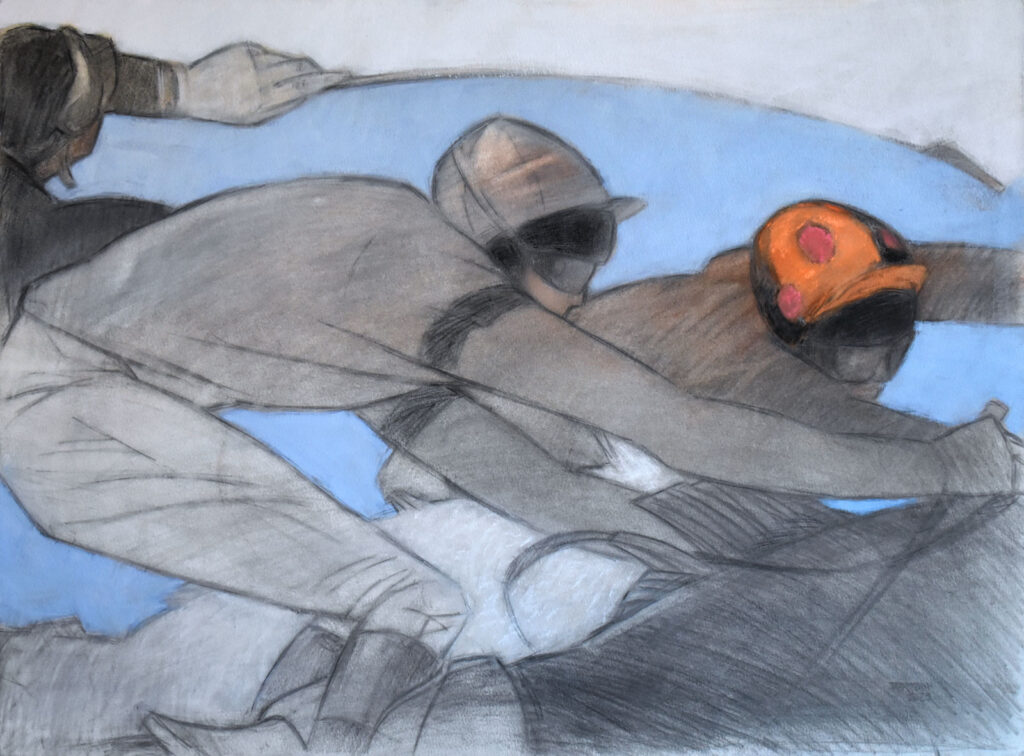

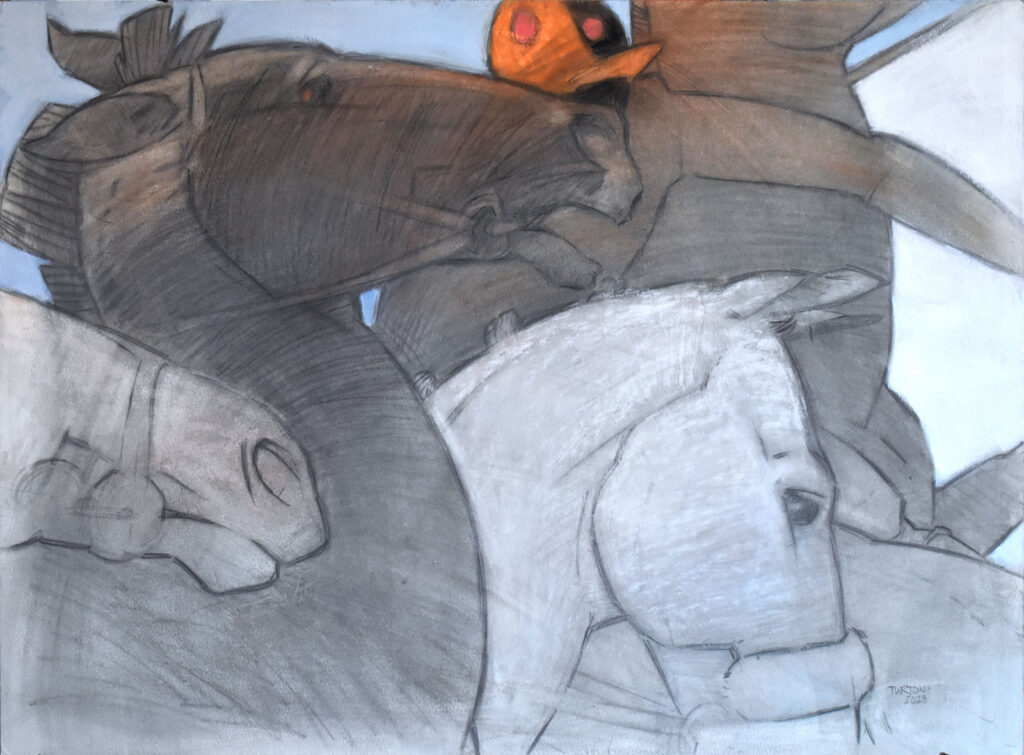
Many of your horse paintings feel more about mood than about narrative. Is that intentional, or does the story emerge as the painting develops?
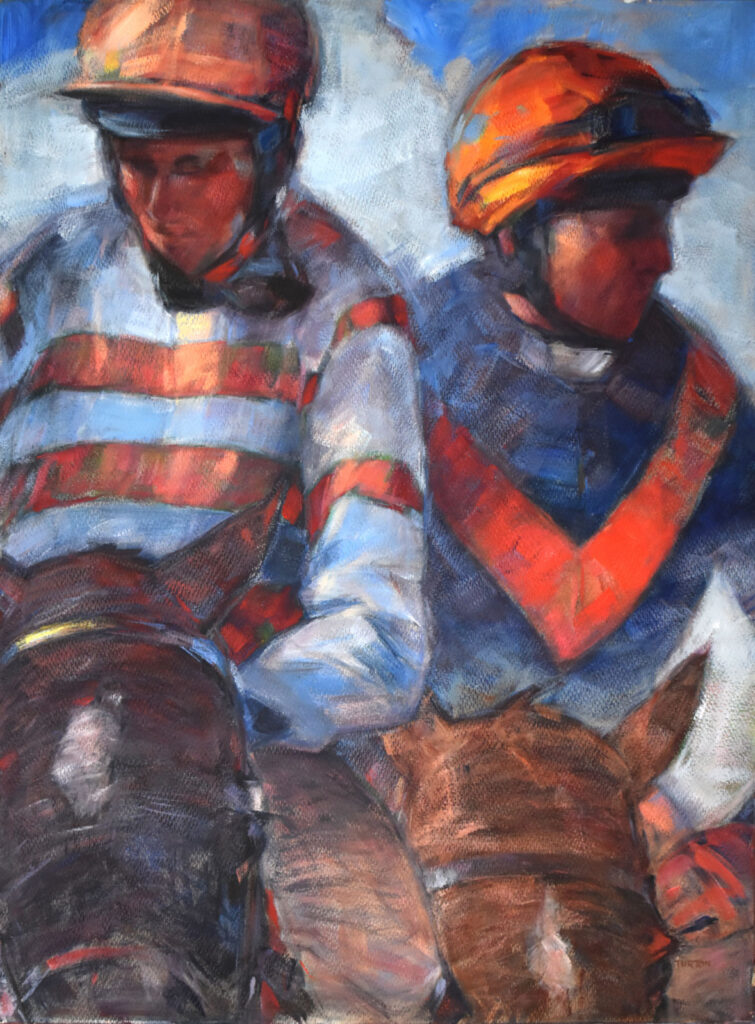
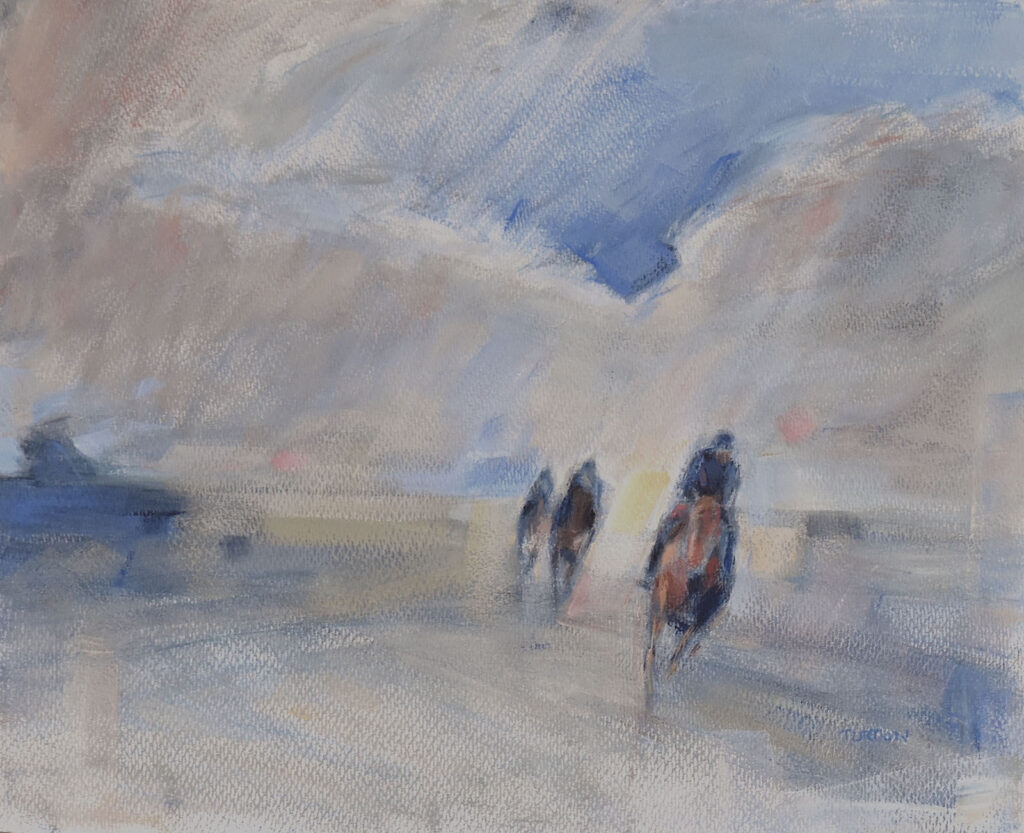
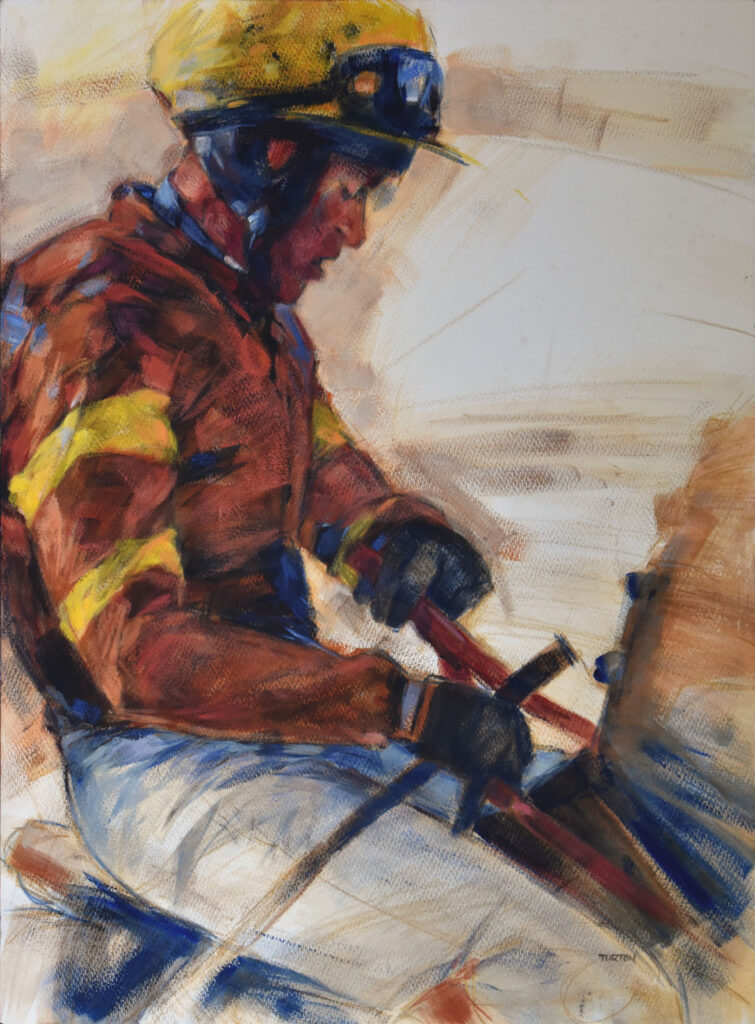
An ongoing theme I’m working on is a series of jockeys and horses. These paintings are a bit more intimate, as I try to get closer to the jockey to reflect a moment.
When I’m at the races, I soak up the atmosphere. The hub-bub, the excitement, jockeys in their bright silks, Thoroughbreds presented in perfect condition—there’s a sense of anticipation in the air. Beneath their skin lie bone, sinew, and muscle.
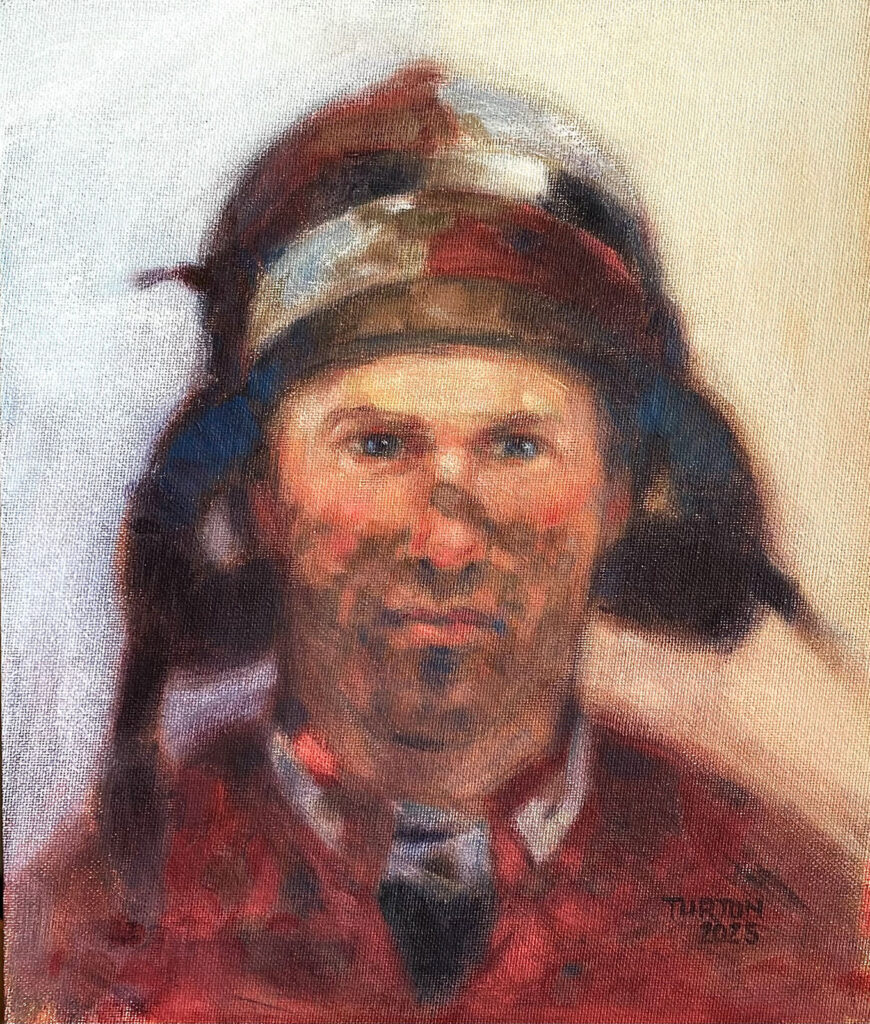
Acrylics seem to be your preferred medium. Can you explain why and how you maximize their properties?
I predominantly work in acrylic, and I love its versatility and quick drying time. I try to balance color and form, contrasting delicate marks with bold brushwork and flat areas of color. Sometimes I draw marks into the painting, so each work has a history of mark-making.
Acrylic can be used wet-on-wet, blending color into color before the paint dries, which suits my style. Or you can apply paint thinned with water and use it like watercolor paint. Alternatively, you can paint in blocks of solid, flat color.
I continuously draw and make sketches from life and from varied references.
You’ve been described as a “painter’s painter.” How do you interpret that description?
I have been described as a painter’s painter. I think this means there is intrinsic beauty in the mark-making and composition—a process I use to capture a subject’s essence, encompassing both movement and stillness. Other painters seem to enjoy looking at my work.
Do you always know when a painting is finished? Do you ever revisit completed works?
Interestingly, I find it hard to judge when a painting is complete and can easily overwork it. When I’m nearing completion, I will walk away from the studio and take a break, then come back and revisit it multiple times, generally simplifying overworked areas and adjusting tonal areas to ensure the piece works as a painted composition, not just a simple, realistic rendition.
On occasion, I’ve gone back to paintings years later and made tiny adjustments.
Your list of awards and exhibitions is extensive. Was there a particular recognition as a young artist that propelled your motivation and confidence to pursue art professionally?
I expect, like most painters/creatives, it goes back to childhood, when I always enjoyed being creative, making models, drawing, and creating things in wood. I even cut my finger badly with a knife while trying to make a replacement chess piece.
At school, I excelled in creativity, and I was fortunate to have a good art teacher who encouraged me. It was this teacher who suggested that my friend and I enter a national school’s art competition, which we won with a life-sized depiction of my grandmother.
A little bit about me
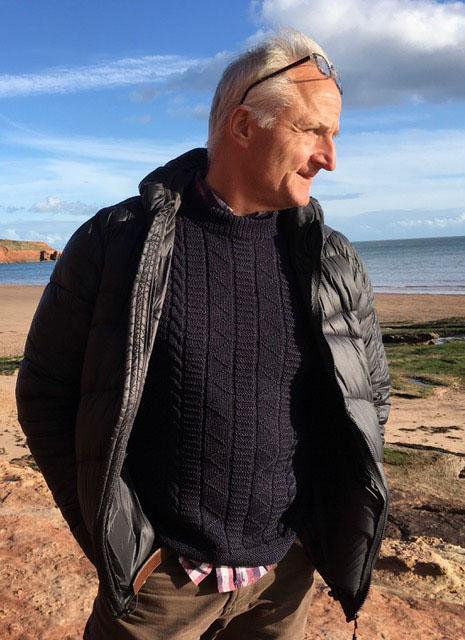
I’m 68 years old and live in Gloucestershire. Sadly, my first wife lost her battle with cancer 13 years ago. However, I have remarried, and we are very happy together, traveling and enjoying our children and grandchildren. I still retain some of the adventurous spirit of my youth and regularly mountain bike (breaking my collarbone last year) and explore our coast and rivers on my stand-up paddleboard. I hope some of this spirit is imparted into my paintings.
After leaving college, like many artists, I had to work in other trades to supplement my desire to create. However, I was fortunate to secure a position as an artist at a recognized studio. There, I learned to paint under the guidance of a talented mentor.
Assorted jobs followed, along with successful exhibitions and sales of paintings. I’ve produced public artwork (paintings and mosaics) and served a stint as an artist-in-residence. Interestingly, the range of jobs I’ve had has kept me grounded, broadened my experiences, and added to my creativity.
To see this feature in the digital magazine, click here. To see more of EQ Living’s artist features, click here.