
 Sarah Lessler
How the Spotted Coach Dog Became an American Icon
While the name points to the Dalmatian coast of Croatia, the breed’s lineage is a patchwork of European and Asian influences. For centuries, these dogs served as hunters, retrievers, and guards before finding their defining niche as carriage dogs.
The breed’s rise as a carriage dog traces to the 17th and 18th centuries, when the British aristocracy began importing Dalmatians after observing them on the European continent. Young noblemen on the Grand Tour noticed the dogs trailing horse-drawn teams in Italy and the Balkans—animals that didn’t merely follow carriages but seemed to crave proximity to the horses.
The Physics of the Run
Most dogs are built for sprinting, but the Dalmatian was created for the long haul. A rhythmic, tireless gait let them keep pace with a horse team for 20 or 30 miles at a stretch. A well-trained coach dog ran not behind the carriage but under the rear axle or alongside the pole—the shaft between the lead horses—staying close enough to escape road dust yet clear of a fatal kick.

A Natural Affinity
Dalmatians have a documented affinity for horses that most breeds lack. When a carriage stopped at an inn, the dogs lived in the stables, sleeping beside the horses and serving as an alarm system against thieves. Stable masters noticed that the two species formed a genuine cross-species bond—the dogs calming animals that other breeds would spook.
Early adopters prized Dalmatians for aesthetics. Nicknamed “Plum Pudding Dogs” for their spotted coats, they were status symbols in an era when a carriage announced social standing. But the dogs quickly proved their utility. Road travel was dangerous, and the Dalmatian filled a gap no other breed could: a muscular, medium-sized guardian that could run at 15 mph for hours. By the late 1700s, the role was standardized. George Washington kept Dalmatians at Mount Vernon for the same reason: they wouldn’t spook his horses but would absolutely spook a thief.
Training the “Axle Dog”
Puppies raised in stables became imprinted on horses. As they matured, they learned to find the protected space beneath the carriage—not for show, but because a dog under the axle was a hidden alarm, ready to intercept anyone grabbing the horses’ bridles or the driver’s luggage.
The Shift to the Firehouse
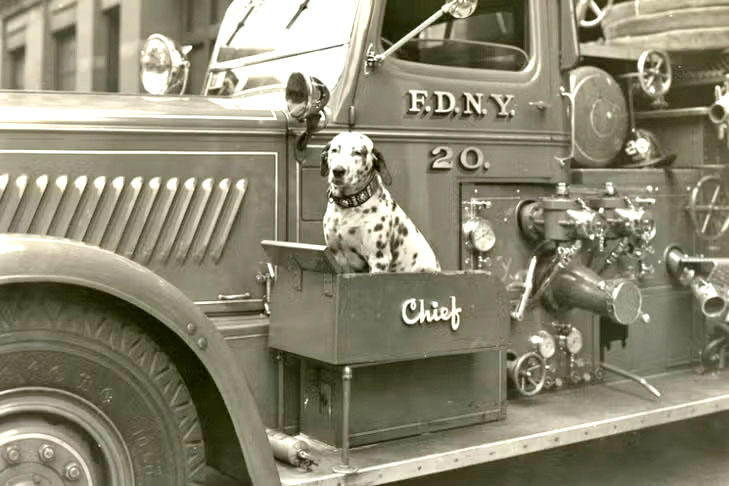
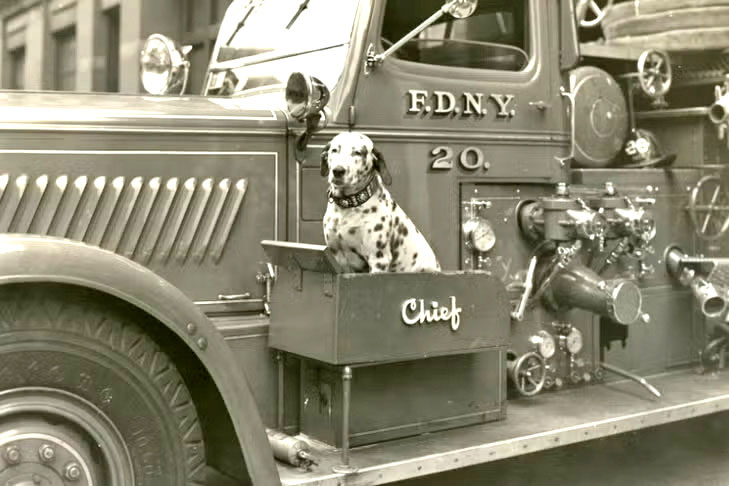
The transition to firefighting in the 1800s was a natural extension of carriage work. Early fire engines were horse-drawn tankers navigating crowded city streets at significant speed. Dalmatians ran ahead as living sirens, clearing pedestrians and wagons, then guarded the horses at the scene to keep them calm amid smoke and flame. Even as engines replaced horses in the early 20th century, the Dalmatian remained—shifting from working partner to firehouse mascot.
The Modern Echo
The automobile retired the Dalmatian from professional life, and without a carriage to follow, the breed’s considerable energy can prove challenging for modern owners. But the history is instructive: these were not pets but working components of a transport system, refined over generations for a specific job. The spots catch the eye first. It is the endurance and instincts beneath them that tell the real story.